BRACERS Record Detail for 20348
To access the original letter, email the Russell Archives.
BR TO PATRICIA RUSSELL, 15 APRIL 1939
BRACERS 20348. ALS. McMaster. Russell 33 (2013): 130–3
Edited by M.D. Stevenson. Reviewed by K. Blackwell
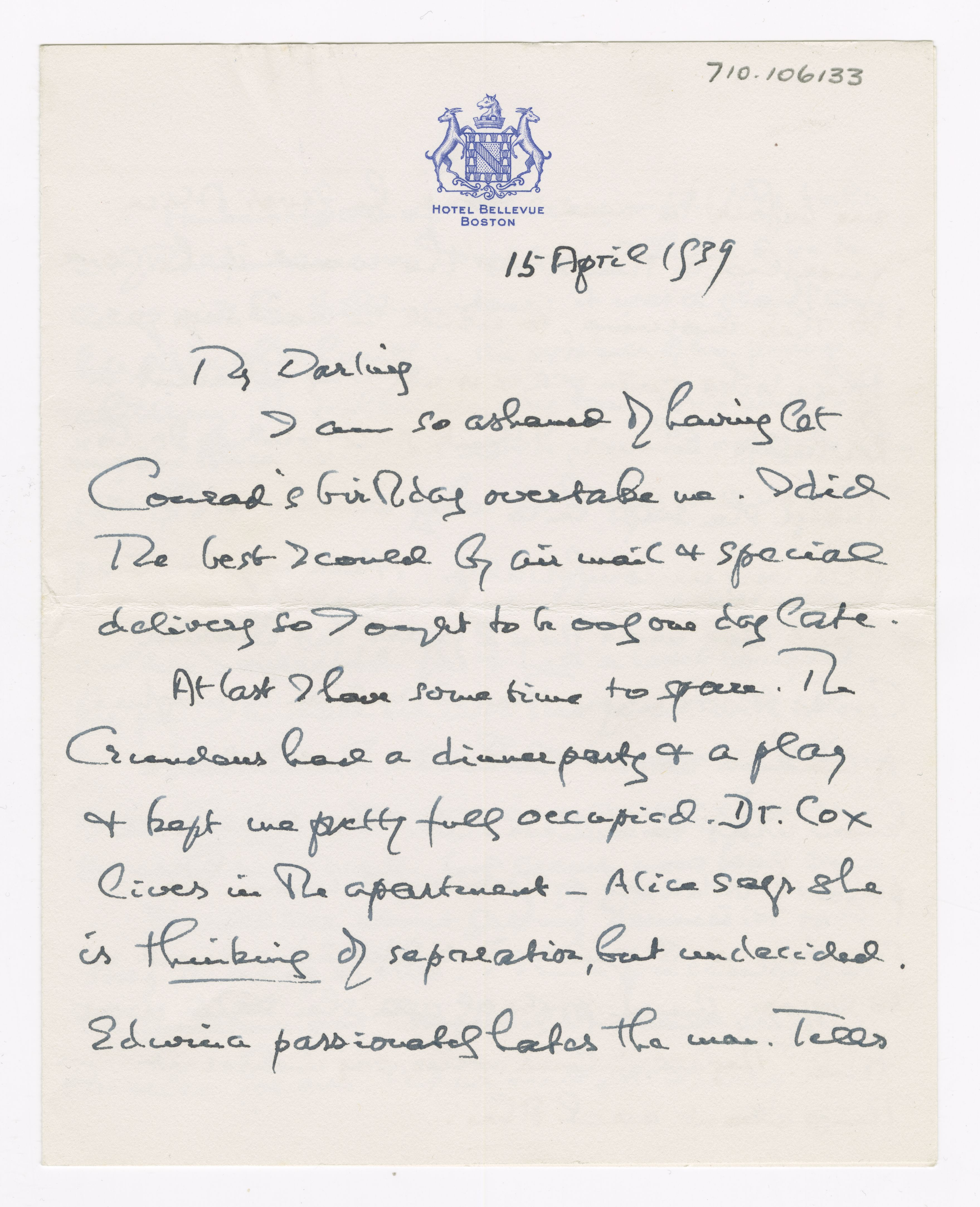
<letterhead>
<crest>
HOTEL BELLEVUE
BOSTON1, 2
15 April 1939
My Darling
I am so ashamed of having let Conrad’s birthday overtake me. I did the best I could by air mail and special delivery so I ought to be only one day late.
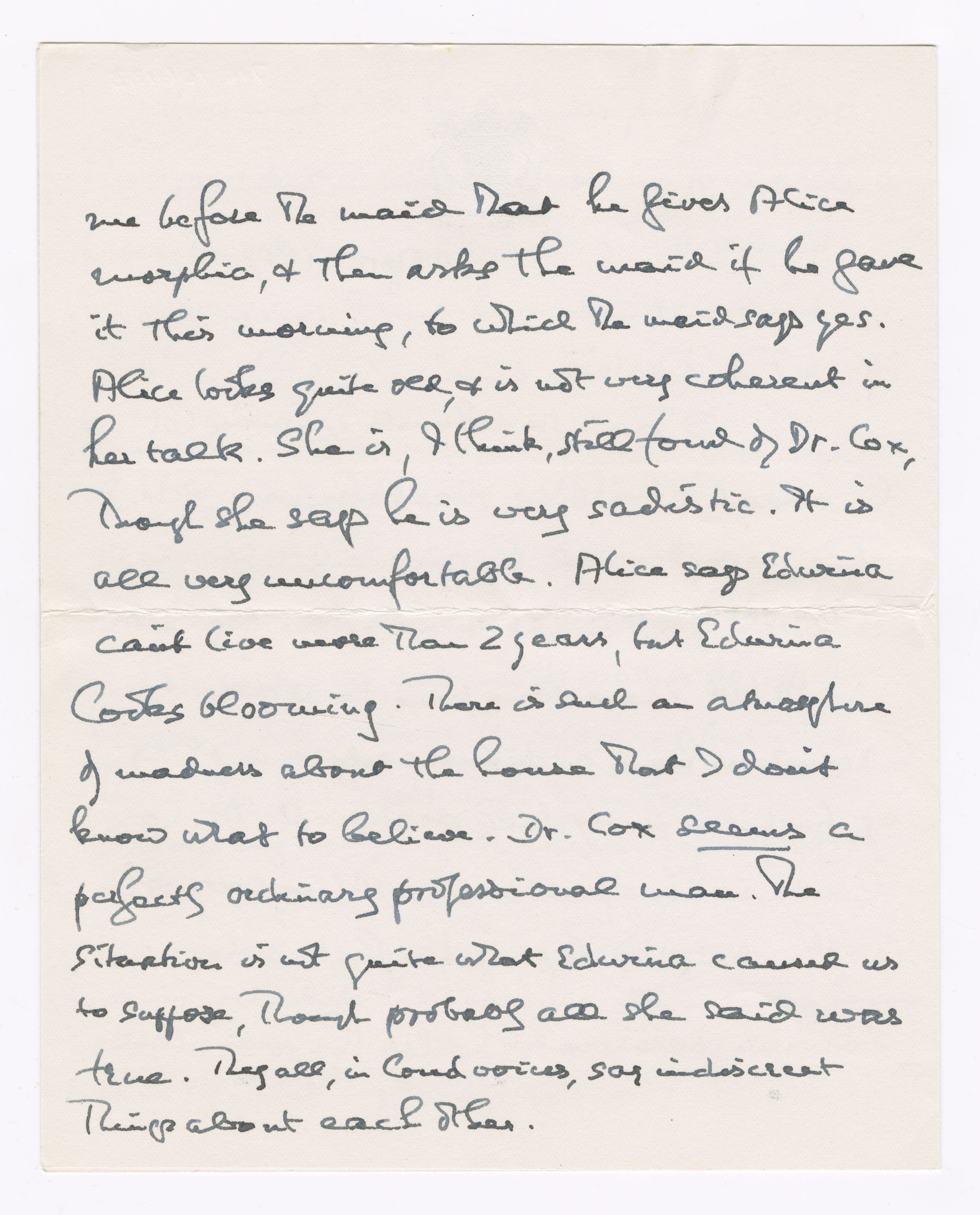
At last I have some time to spare. The Crundens had a dinner party and a play and kept me pretty full occupied. Dr. Cox3 lives in the apartment — Alice says she is thinking of separation, but undecided. Edwina4 passionately hates the man. Tells me before the maid that he gives Alice morphia, and then asks the maid if he gave it this morning, to which the maid says yes. Alice looks quite old, and is not very coherent in her talk. She is, I think, still fond of Dr. Cox, though she says he is very sadistic. It is all very uncomfortable. Alice says Edwina can’t live more than 2 years, but Edwina looks blooming. There is such an atmosphere of madness about the house that I don’t know what to believe. Dr. Cox seems a perfectly ordinary professional man. The situation is not quite what Edwina caused us to suppose, though probably all she said was true. They all, in loud voices, say indiscreet things about each other.
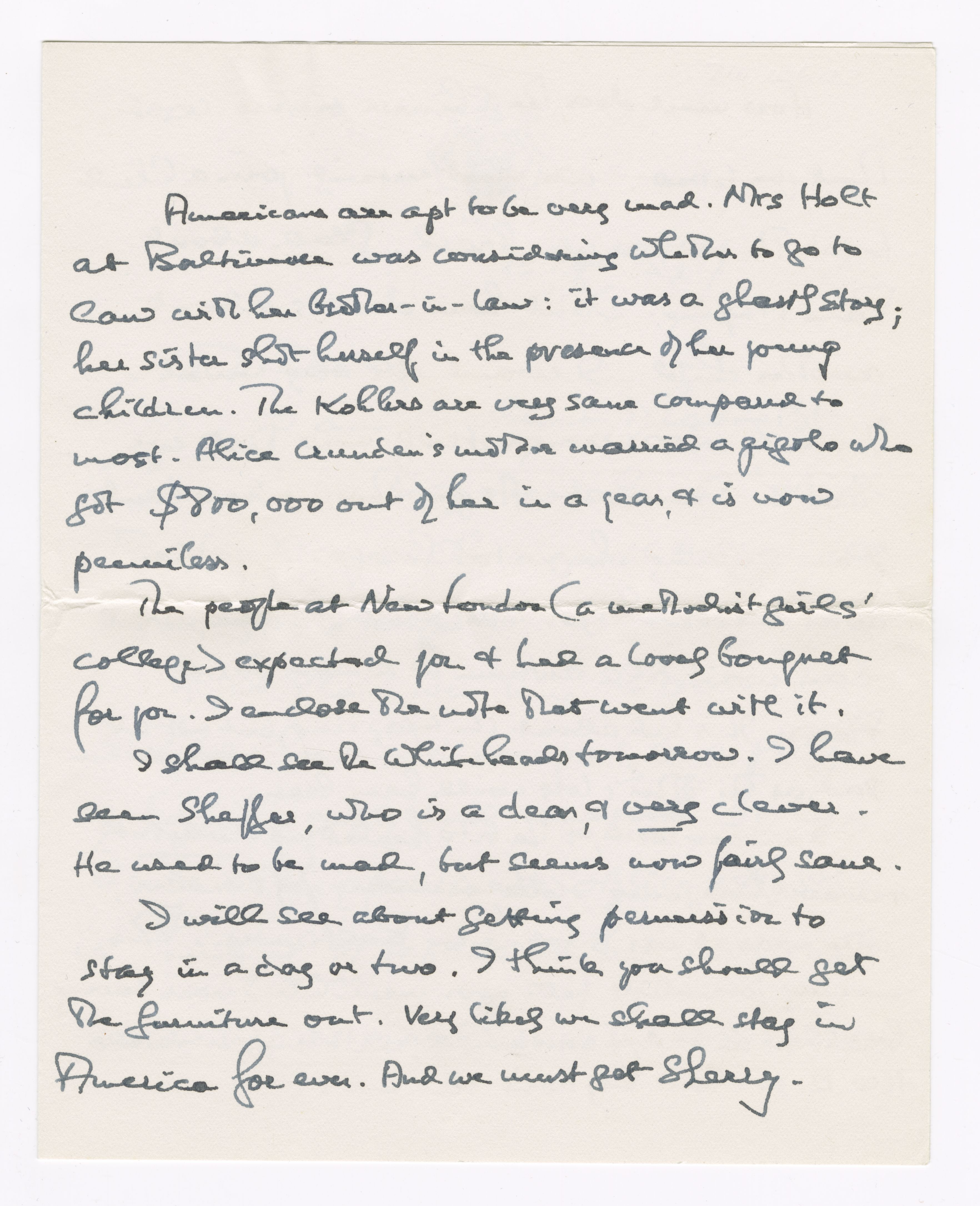
Americans are apt to be very mad. Mrs Holt at Baltimore was considering whether to go to law with her brother-in-law: it was a ghastly story; her sister shot herself in the presence of her young children.5 The Kohlers6 are very sane compared to most. Alice Crunden’s mother married a gigolo who got $800,000 out of her in a year, and is now penniless.7
The people at New London (a methodist 〈sic〉 girls’ college) expected you and had a lovely bouquet for you. I enclose the note that went with it.8
I shall see the Whiteheads9 tomorrow. I have seen Sheffer, who is a dear, and very clever. He used to be mad, but seems now fairly sane.10
I will see about getting permission to stay in a day or two. I think you should get the furniture out. Very likely we shall stay in America for ever. And we must get Sherry.
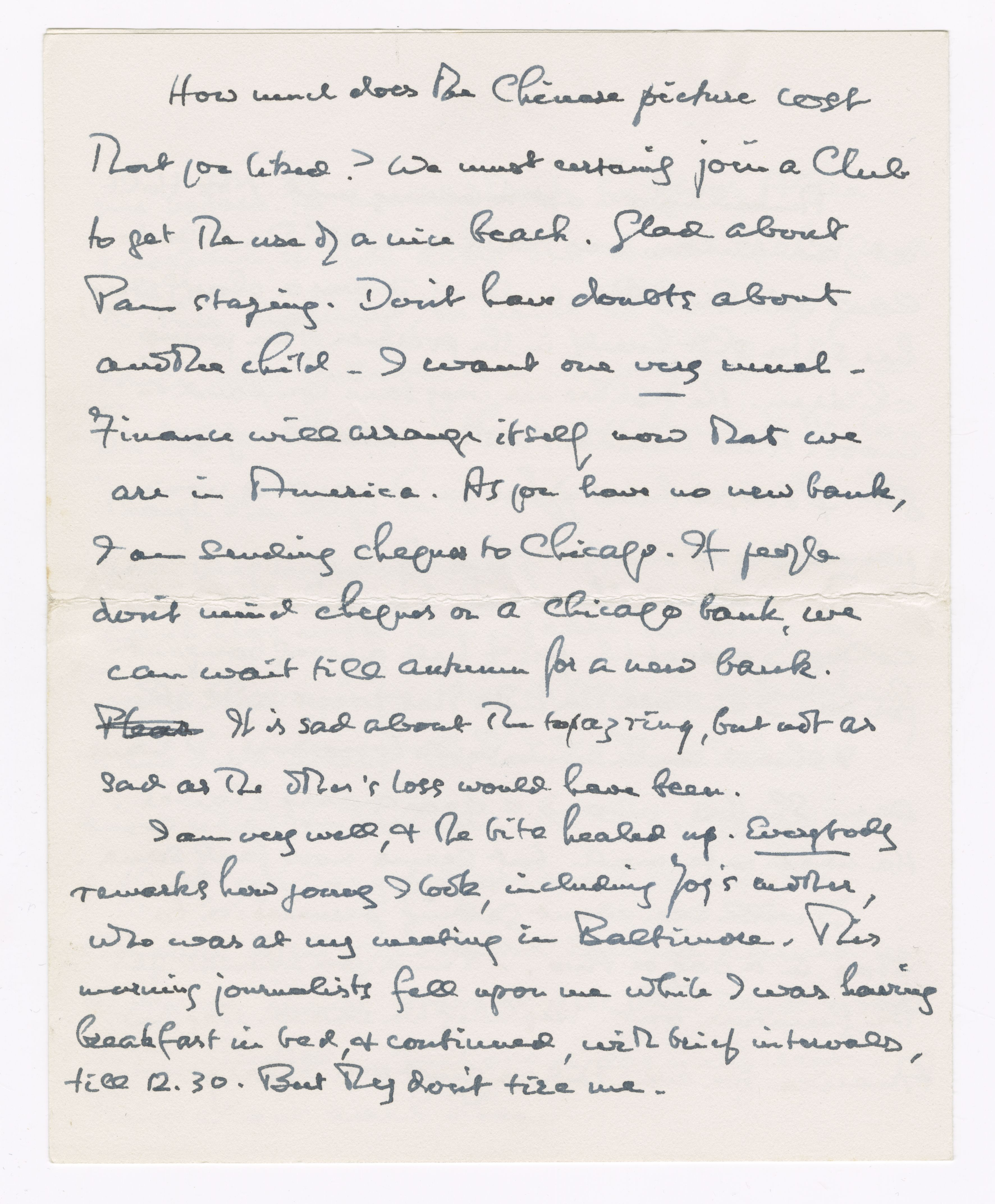
How much does the Chinese picture cost that you liked? We must certainly join a Club to get the use of a nice beach. Glad about Pam11 staying. Don’t have doubts about another child — I want one very much. Finance will arrange itself now that we are in America. As you have no new bank, I am sending cheques to Chicago. If people don’t mind cheques on a Chicago bank, we can wait till autumn for a new bank.a It is sad about the topaz ring,12 but not as sad as the other’s loss would have been.
I am very well, and the bite healed up.13 Everybody remarks how young I look, including Joy’s mother,14 who was at my meeting in Baltimore. This morning journalists fell upon me while I was having breakfast in bed, and continued, with brief intervals, till 12.30.15 But they don’t tire me.
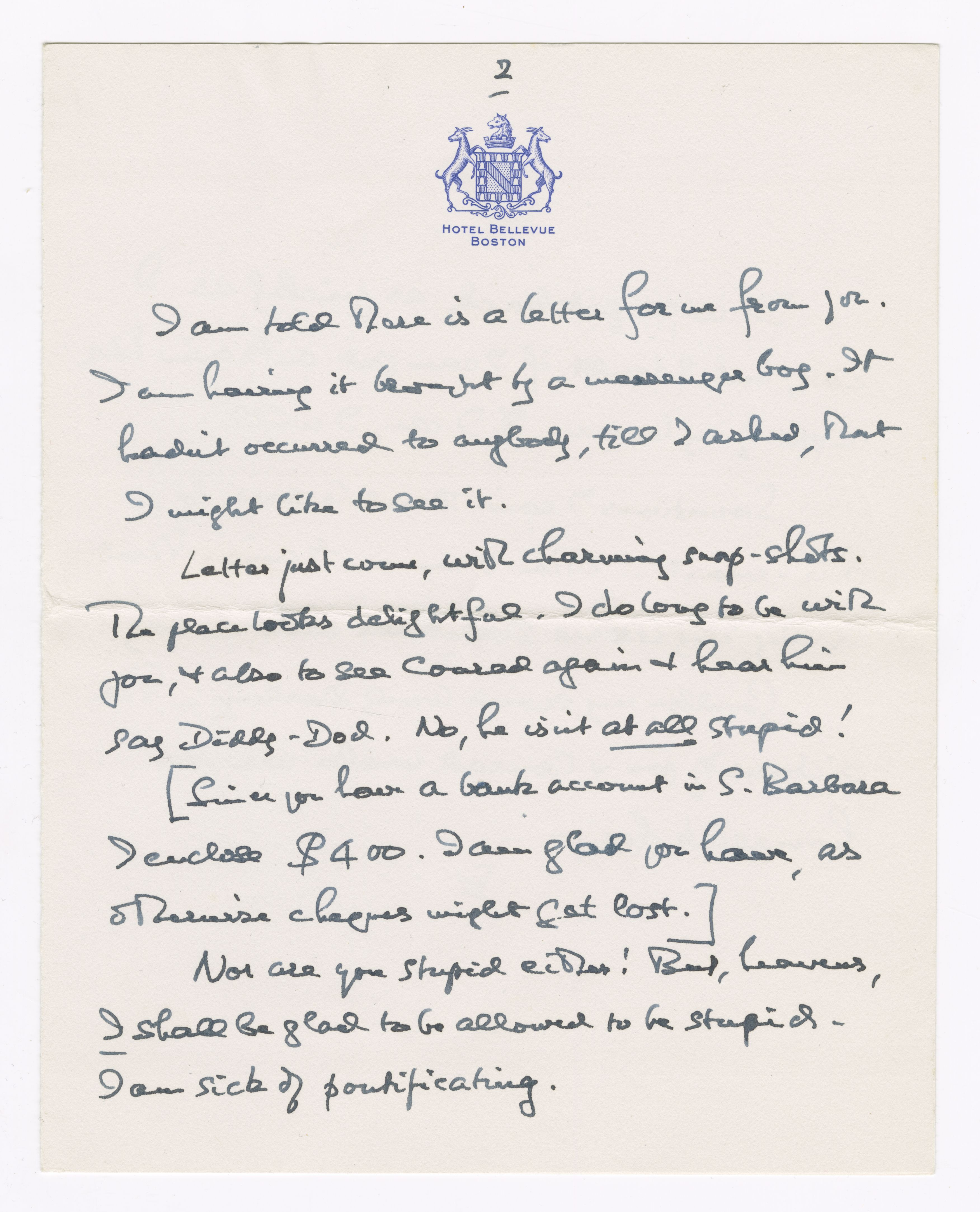
I am told there is a letter for me from you. I am having it brought by a messenger boy. It hadn’t occurred to anybody, till I asked, that I might like to see it.
Letter just come, with charming snap-shots. The place looks delightful. I do long to be with you, and also to see Conrad again and hear him say Diddy-Dod. No, he isn’t at all stupid!
[Since you have a bank account in S. Barbara I enclose $400. I am glad you have, as otherwise cheques might get lost.]
Nor are you stupid either! But, however, I shall be glad to be allowed to be stupid. I am sick of pontificating.
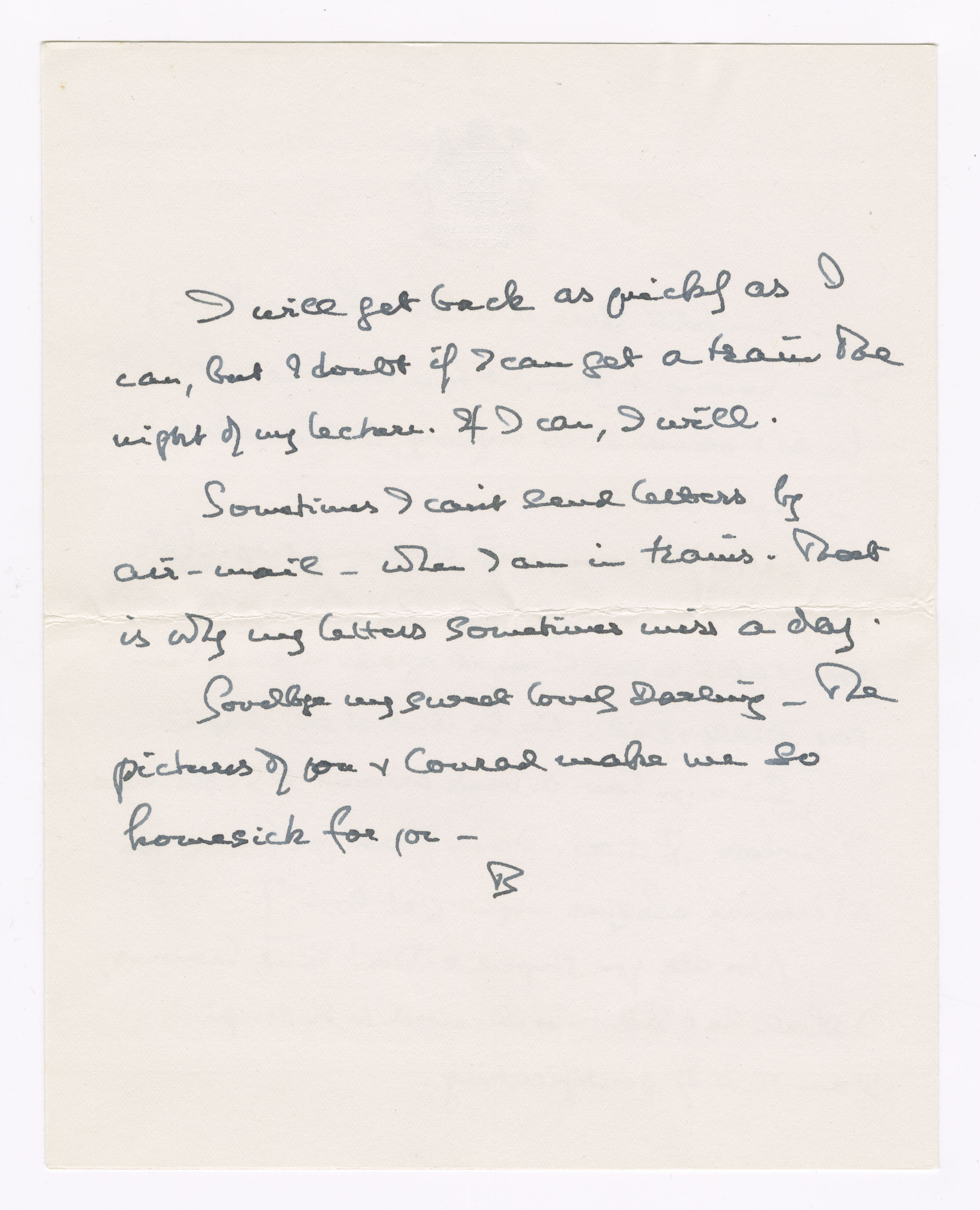
I will get back as quickly as I can, but I doubt if I can get a train the night of my lecture. If I can, I will.
Sometimes I can’t send letters by air-mail — when I am in trains. That is why my letters sometimes miss a day.
Goodbye my sweet lovely Darling — the pictures of you and Conrad make me so homesick for you.
B
- 1
[document] The letter was published in Michael D. Stevenson, ed., “‘In Solitude I Brood On War’: Bertrand Russell’s 1939 American Lecture Tour”, Russell 33 (2013): 101–42 (at 130–3).
- 2
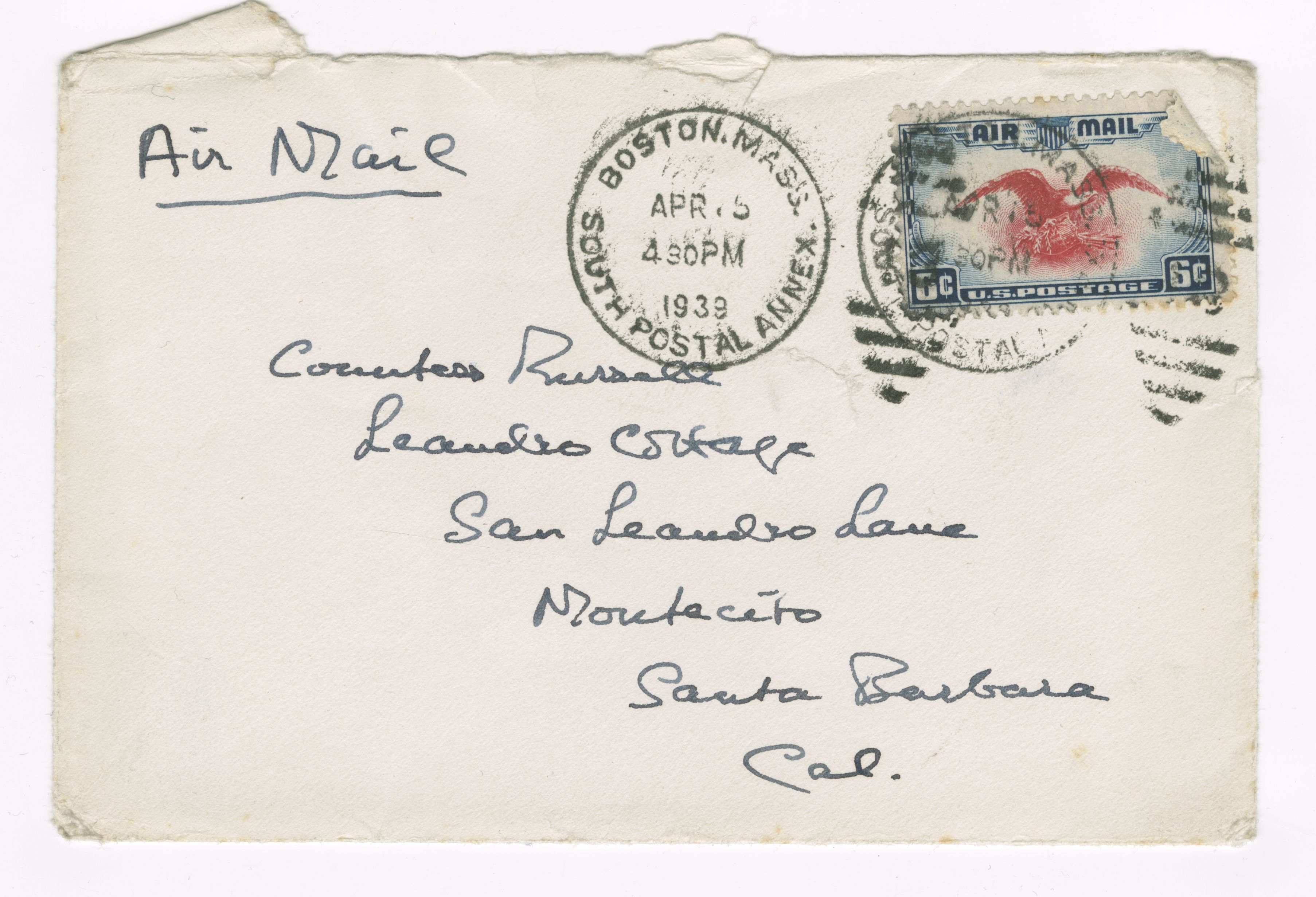
[envelope] Air Mail | Countess Russell | Leandro Cottage | San Leandro Lane | Montecito | Santa Barbara | Cal. Pmk: BOSTON MASS | APR 15 | 430PM | 1939 | SOUTH POSTAL ANNEX | [6¢ air mail stamp]
- 3
Dr. Cox After divorcing Walter Crunden, Alice married Gerard Hutchinson Cox (1877–1951) in 1937. Cox received his medical degree from Columbia University in 1903 and practised otolaryngology; his first marriage had ended in divorce five days before he married Crunden (see “Mrs. Alice Crunden, Bride of Physician”, New York Times, 9 Oct. 1937, p. 22). Although BR provides a description of a poisoned relationship in several letters to Peter while he stayed with the Coxes during this tour, it appears that Cox and Crunden remained married until his death.
- 4
Edwina Little biographical information can be located about Edwina Crunden (born c.1915), Alice Crunden’s only child from her first marriage. From this letter and Letter 20, it appears that she may have suffered from a heart ailment.
- 5
her sister shot herself in the presence of her young children Details of this family tragedy cannot be fully verified. It appears that the sister of Olivia Holt referred to by BR was Pauline Starbuck, who died in 1935. A 1937 probate notice for the estate of Holt’s aunt mentions Olivia and her other sister, Catharine, as beneficiaries, as well as two Starbuck children (see “Wills for Probate”, New York Times, 14 May 1937, p. 46). Biographical information about Pauline’s husband (Olivia Holt’s brother-in-law), Charles Starbuck, was not located.
- 6
Kohlers See Letter 10.
- 7
Alice Crunden’s mother married a gigolo who got $800,000 out of her in a year, and is now penniless. Edna Crunden (née Bradley, 1870–1936), Alice’s mother, married theatre impresario Raymond W. Moore — twenty years her junior — in 1935 after her first husband had died in 1929. Moore unsuccessfully sued his wife’s estate. Instead of the interest income, the court in 1938 awarded Moore nearly $104,000 in cash, which, according to BR, he had squandered less than a year later (see “Moore Estate Near Million”, Milwaukee Journal, 11 June 1938, p. 6).
- 8
I enclose the note that went with it. Not in the Russell Archives.
- 9
WhiteheadsAlfred North Whitehead (1861–1947), BR’s mentor at Trinity College, Cambridge, and coauthor of Principia Mathematica, left England in 1924 to become Professor of Philosophy at Harvard University. In 1891, he married Evelyn Wade (1865–1961), a woman who exerted a profound influence on BR’s life. After seeing her suffer through illness in 1901, BR experienced a dramatic conversion that temporarily possessed him with a “sort of mystic illumination” (Auto. 1: 149).
- 10
Sheffer, who is a dear, and very clever. He used to be mad, but seems now fairly sane Henry M. Sheffer (1883–1964) is best known as the discoverer of the “Sheffer stroke”, a binary truth-functional operator used by BR in the second edition of Principia Mathematica. Sheffer taught at Harvard University from 1917 to 1952, achieving the rank of full professor in 1938. Sheffer first met BR at Cambridge in 1910, and the two corresponded frequently thereafter until 1929. As BR indicates, Sheffer experienced numerous nervous breakdowns throughout his career (see Michael Scanlan, “The Known and Unknown H. M. Sheffer”, Transactions of the Charles S. Peirce Society, 36 [2000]: 193–224).
- 11
Pam Few biographical details can be found concerning Pamela Campbell, but she was Conrad Russell’s governess.
- 12
It is sad about the topaz ring Details of this incident involving a topaz ring were not found.
- 13
the bite healed up Presumably, an insect bit BR at some point during his tour.
- 14
Joy’s mother Joy Corbett attended Beacon Hill School; her mother, Una Corbett, had also attended BR’s address in Baltimore during his 1927 American lecture tour (see Corbett to BR, 3 Nov. 1927, RA3 Rec. Acq. 1,185).
- 15
This morning journalists fell upon me while I was having breakfast in bed, and continued, with brief intervals, till 12.30. Records of these morning interviews have not been located, except for that by Julius Kaplan (“Earl Russell in Blue Pyjamas Talks Marriage, War, Peace”, Boston Evening Transcript, 15 April 1939, sec. 1, p. 2). BR did conduct a dinner interview with a college journalist at the Ritz Hotel while in Boston (see “Bertrand Russell sees U.S.A. Dictator after Next Conflict”, The Harvard Crimson, 17 April 1939, p. 1). In a “The Talk of the Town” column, Roger Angell [1920– 2022] hinted who the college journalist was, and confirmed it was he in a 1970 letter to K. Blackwell.
Textual Notes
- a
bank “Please” crossed out after “bank.”