BRACERS Record Detail for 20259
To access the original letter, email the Russell Archives.
US Lecture Tour (1951)
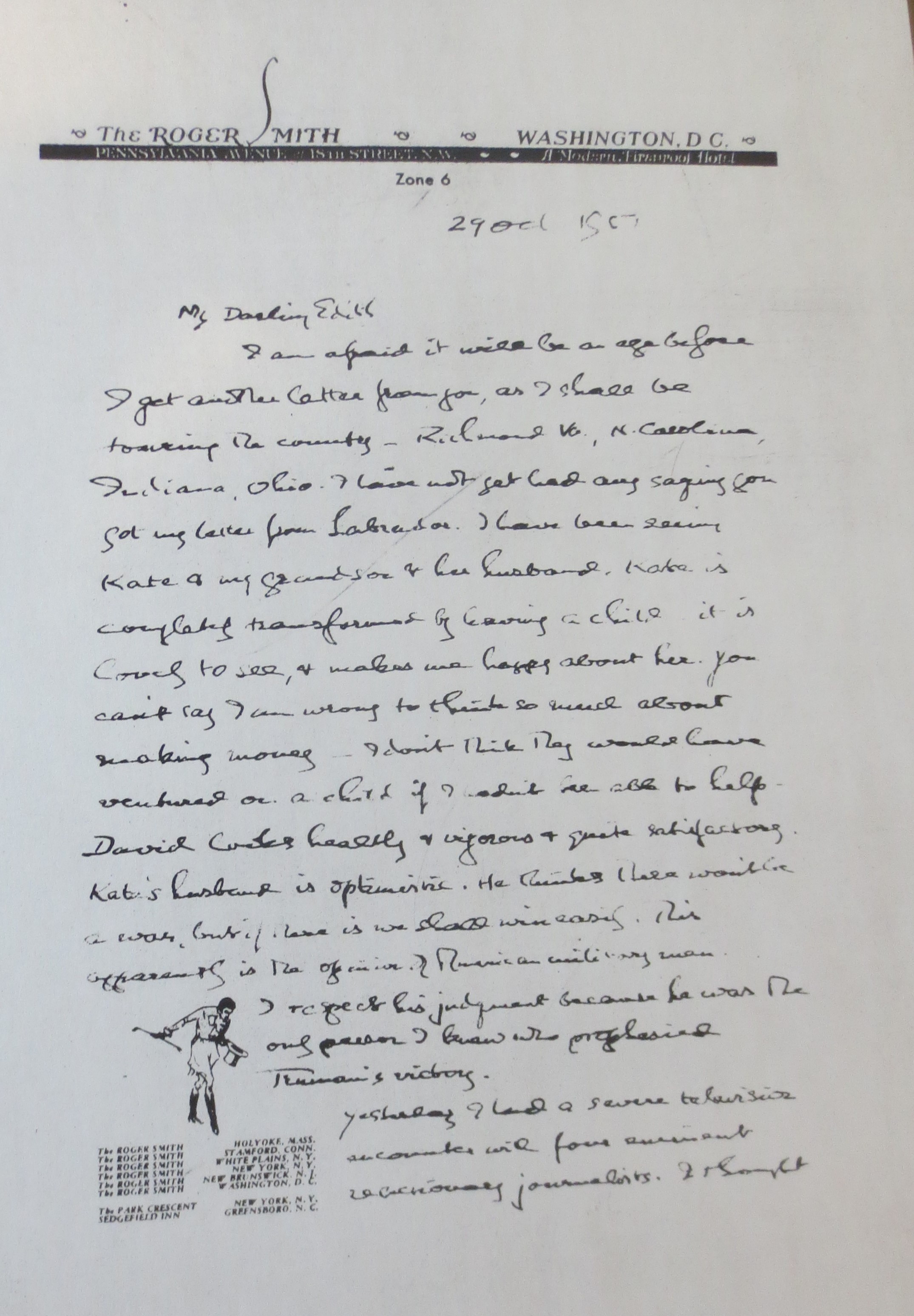
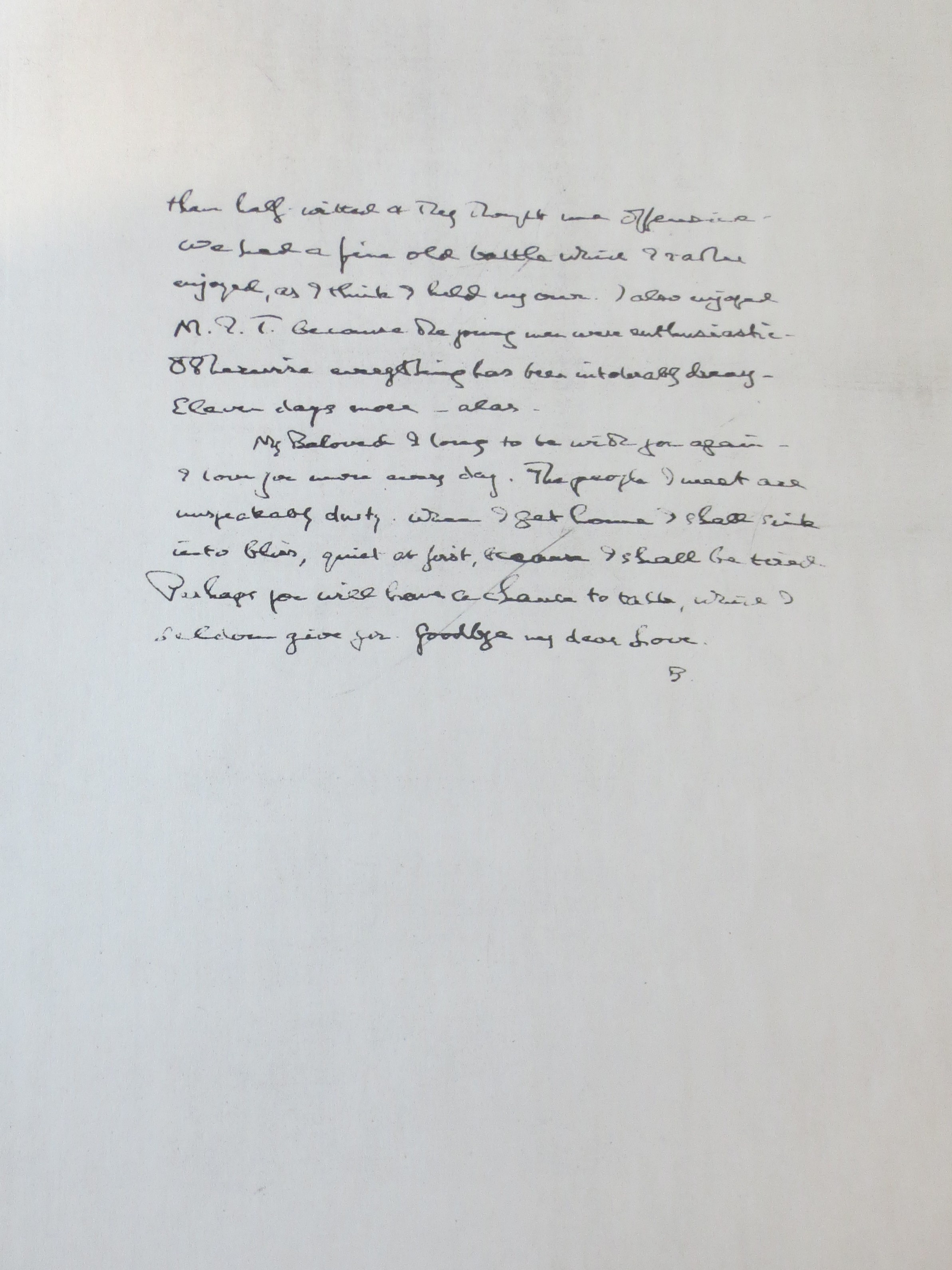
"The Roger Smith" "My Darling Edith I am afraid it will be an age before I get another letter from you, as I shall be touring the country—Richmond VA., N. Carolina, Indiana, Ohio." "Yesterday I had a severe television encounter with four eminent reactionary journalists. I thought them half-witted and they thought me offensive—we had a fine old battle which I rather enjoyed, as I think I held my own. I also enjoyed M.I.T. because the young men were enthusiastic—"
BR TO EDITH RUSSELL, [29 OCT. 1951]
BRACERS 20259. ALS. McMaster. SLBR 2: #513
Edited by A.G. Bone and N. Griffin. Reviewed by S. Turcon
<letterhead>1
The Roger Smith
Pennsylvania Avenue at 18th Street, N.W.
Washington, D.C.
My Darling Edith2
I am afraid it will be an age before I get another letter from you, as I shall be touring the country — Richmond Va., N. Carolina, Indiana, Ohio. I have not yet had any saying you got my letter from Labrador.3 I have been seeing Kate and my grandson4 and her husband.5 Kate is completely transformed by having a child — it is lovely to see, and makes me happy about her. You can’t say I am wrong to think so much about making money — I don’t think they would have ventured on a child if I hadn’t be able to help. David looks healthy and vigorous and quite satisfactory. Kate’s husband is optimistic. He thinks there won’t be a war, but if there is we shall win easily. This apparently is the opinion of American military men. I respect his judgment because he was the only person I knew who prophesied Truman’s victory.
Yesterday I had a severe television encounter with four eminent reactionary journalists.6 I thought them half-witted and they thought me offensive. We had a fine old battle which I rather enjoyed, as I think I held my own. I also enjoyed M.I.T.7 because the young men were enthusiastic. Otherwise everything has been intolerably dreary. Eleven days more — alas.
My Beloved I long to be with you again. I love you more every day. The people I meet are unspeakably dusty. When I get home I shall sink into bliss, quiet at first, because I shall be tired. Perhaps you will have a chance to talk, which I seldom give you. Goodbye my dear Love.
B.
- 1
[document] The letter was edited from a photocopy of the signed original written in BR’s hand on the recto and verso of a single leaf of letterhead from the Roger Smith Hotel, Washington, DC.
- 2
[recipient] See BRACERS 20255, n. 2.
- 3
I have not yet had any saying you got my letter from Labrador. Where his plane was delayed for a day on the way over.
- 4
my grandson David Tait (1951–2016).
- 5
her husband BR’s son-in-law Charles William Tait (1923–2017) was an expert linguist whose language skills had been utilized by American military intelligence during World War II. After his discharge from the U.S. Army, Tait returned to Harvard (where he met Kate, whom he married in 1948) and completed a degree in comparative philology before enrolling in graduate school. Early in 1950 he joined the intelligence branch of the State Department and became an analyst of Czechoslovakia in the Eastern Europe section. He continued in this role until entering a Virginia Seminary in 1958 to train for the Episcopalian ministry. After he was ordained a priest three years later, he travelled with his family to Uganda to undertake missionary work.
- 6
severe television encounter with four eminent reactionary journalists On 28 October BR appeared on NBC’s Meet the Press (see 76 in Papers 26). His interlocutors were Dr. Ruth Alexander (1892–1980), a conservative economist and editorialist and columnist for the Hearst Press; Alistair Cooke (1908–1994), foreign correspondent for the Manchester Guardian and presenter since 1946 of BBC radio’s hugely popular Letter from America; Ernest K. Lindley (1900–1979), Washington bureau chief of Newsweek from 1941 until his appointment in 1961 as special assistant to Secretary of State Dean Rusk; and James Reston (1909–1995), an influential diplomatic correspondent and columnist for the New York Times, whose fifty-year association with the newspaper included a lengthy spell (from 1953 to 1964) as head of its Washington bureau. BR’s epithet applies most readily to Alexander, but he received the most sustained grilling from the programme’s host, Lawrence Spivak (1900–1994).
- 7
I also enjoyed M.I.T. See BRACERS 20258, n. 11.